

What is Flatbed Semi Trailer
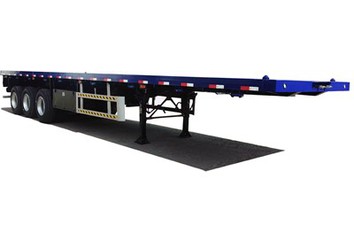
A flatbed semi trailer is a typical open deck equipment that has no roof nor sides. It is mainly used for transporting heavy, oversized, wide and indelicate goods such as machinery, building supplies or equipment. The flatly shaped body makes it much easier to load and unload goods.
Benefits of Flatbed Semi Trailer
Flexibility: Flatbed semi trailer offer greater flexibility when transporting heavy equipment. These trailers are versatile and can accommodate loads of all sizes and shapes, making them ideal for hauling construction equipment, farm equipment, and other heavy machinery. This flexibility is especially useful when transporting odd-shaped or oversized equipment that cannot fit in an enclosed trailer.
Ease of loading and unloading: Flatbed semi trailers provide a smooth and easy process for loading and unloading heavy equipment. Unlike enclosed trailers, the unit can be loaded and unloaded from any angle, making the process simple and efficient. This easy loading and unloading saves time and reduces labor costs, making it ideal for businesses that need to transport heavy equipment on a regular basis.
Weight Capacity: Flatbed semi trailers are designed to handle a wide range of weight capacities. With durable construction, these trailers can safely transport large and heavy equipment without fear of damage or accidents. This weight capacity makes flatbed semi trailers the perfect choice for businesses that need to transport heavy machinery on a regular basis.
Protection: Flatbed semi trailers provide excellent protection for transported equipment. The openness of the trailer makes it easy to inspect the load to ensure equipment is safe and undamaged. This protection is critical to ensuring that the equipment being transported reaches its destination safely.


Why Choose us
Quality
We offer high quality services and products that are relatable and resonate with your business needs.We have won the satisfaction and trust of our customers and have been awarded the title of "National Special Vehicle Quality Stable Qualified Enterprise".
Before sales service
We will supply 24 hours online service,the specialized sales manager will introduce our semi trailer information details to you for your satisfied if you want to learn more detailed about our products.
After sales service
We can supply one year warranty service after you purchased our trailers.If you are interested in our product,don't hesitate ,just contact us!
Quality services
Our company always adheres to the principle of "customer first, survival based on quality, and development based on reputation", and provides comprehensive and multi-level management system and first-class services to new and old customers.
Types of Flatbed Semi Trailer


Step or drop deck trailer
A step deck trailer, also referred to as a “drop deck” trailer, is a common alternative to the traditional flatbed semi trailer. It offers two bed sections of varying heights: an initial taller upper deck at the top steps down to a lower deck closer to the ground.
Step deck trailers allow for taller loads at their lowest point, making them extremely versatile. That extra bit of clearance can make a big difference while the height variations allow for more cargo options.
Extendable or stretch deck trailer
An extendable or “stretch” deck trailer is similar to the standard flatbed semi trailer trailer but has a built-in sliding mechanism offering the ability to extend the length of the cargo bed. These are ideal for items that need more space lengthwise. Stretch decks are also available in a drop deck style.
In order to account for the added length, owners can attach a bulkhead to the front of the trailer to secure cargo and keep it from coming loose in the event of hard braking. Think of a bulkhead as a vertical partition, important for cargo control, adding an extra barrier and means for securement. Bulkheads can either be flat or have a short return on each side for even more support.
Lowboy or double drop trailer
Also known as a ”double drop,” a lowboy trailer is just as it sounds. In order to sit as low to the ground as possible it utilizes two drops: one drop occurs immediately following the gooseneck (the long neck that hitches the trailer to the truck tractor) and another drop just before the rear trailer wheels.
The drops allow the trailer body to extend below the height of the wheels, maximizing overhead clearance. Lowboy trailers are ideal for hauling items that are extremely tall, as they allow for the most vertical clearance of any flatbed trailer design.
Removable gooseneck trailer (RGN)
An RGN is a unique flatbed design with a gooseneck that can be separated from the rest of the trailer. By removing the neck, the bed can be lowered and used as a ramp for easy loading. They are frequently used to haul oversized heavy machinery such as forklifts and bulldozers, which can be driven right up onto the truck bed for easy hauling.
Conestoga or curtainside trailer
This final flatbed trailer design is an interesting compromise between a standard walled tractor trailer and a flatbed. Curtainside trailers have a built-in sliding tarp mechanism that allows you to cover cargo and protect it from damage and the elements without solid walls. The tarps allow for accessibility on 3 sides when opened, while still providing a layer of protection for sensitive or delicate cargo.
Standard flatbed
A standard flatbed semi trailer typically runs between 48 to 53 feet long, 8.5 feet wide, and 5 feet tall. With a standard 5-foot bed height, they can haul items up to 8.5 feet tall.
Step deck
Step deck trailer length runs between 48 to 53 feet long, with an 8.5 feet width. The upper deck follows a standard 5-foot height with a step down to a 3.6-foot-tall lower deck. The lower deck allows for loads up to 10 feet in height.
Extendable flatbed
Stretch flatbed semi trailers can extend up to 80 feet in length, with a standard 8.5 feet width and 5-foot height. That's quite a bit longer than a 53-foot flatbed, greatly extending capacity for extra-long items.
Lowboy
Common lowboy lengths run between 24 to 29 feet, 8.5 feet wide, with a well height (lowest point) of between 18 and 24 inches. Because they are so low, they have a legal freight height of up to 12 feet.
Curtainside
Curtainside trailers average 48 to 53 feet in length, an 8.5-foot width, 8-foot height, and a standard 5-foot bed height. They do not offer as much height clearance for cargo because of the overhead sliding tarp design.
7 Common Uses for Flatbed Trucks
Transporting Building Materials
In the construction industry, flatbed semi trailer are commonly used as a way to transport building materials, from lumber and bricks to scaffolding and steel beams. One of the big benefits to using flatbed semi trailer to transport these materials is the fact that they can easily be loaded and unloaded, whether by crane or by hand. Some materials can even hang over the edge of a flatbed semi trailer, allowing construction companies to transport oddly shaped building materials as well.
Hauling Equipment
When a job site requires equipment, getting that equipment there safely and efficiently is important. If you've ever been out on a rural highway, you may have seen a flatbed semi trailer hauling some sort of equipment, whether it's a tractor, backhoe, or something else. Safe equipment hauling is one of the biggest benefits to using a flatbed trailer to haul equipment.
Baled Tires
Every year in the United States, millions of tires are stockpiled. This might not seem like a big deal, but these tire stockpiles lead to fire hazards, as well as creating a perfect spot for vermin to make a home. To prevent this, these tires are compressed into bales and hauled away for some other purpose. And of course, flatbed semi trailer are the ideal choice when it comes to hauling baled tires from one spot to another.
Transporting Scrap
No matter what kind of job site you're working on, chances are there's a good amount of cleanup required. One of the most important parts of cleaning up a job site is finding something to do with all the scrap, especially if you're talking about the construction business. Flatbed semi trailer are also used for hauling scrap away from job sites, taking it somewhere that it can be recycled and giving construction crews more space to work.
Other Hauling Needs
The thing that makes flatbed semi trailer so special is the fact that they're incredibly easy to load. No matter what you need to transport, there's a good chance you can get the job done with a flatbed semi trailer. Since flatbed semi trailer also allow for a little overhang when loaded properly, you can even move awkwardly shaped building materials, equipment and scrap on a flatbed semi trailer. Really, you can move just about anything with a good flatbed.
Landscaping
When a homeowner calls a landscaper, they expect that landscaper to take care of any problems they may have around their home. What a lot of homeowners don't consider is the fact that landscaping companies have to find a way to transport brush, trees and other scraps from your home. Flatbed semi trailer are commonly used by landscapers to transport larger trees, landscaping tools and bulk bags of landscaping materials.
Farms
The farm industry is one of the most important in the world, so flatbed semi trailer play a crucial role by supporting this industry. Flatbed semi trailer make it possible to move equipment and supplies long distances down rural highways, which would otherwise be a very dangerous task. This means farms have a way to get all the equipment and supplies they need without having to spend a fortune or find creative hauling solutions, which saves everyone money.
How to Ensure the Welding Quality of Flatbed Semi Trailer?
Cutting
A CNC cutting machine is used to cut out the steel plates including the web plate, reinforcing plate, and accessories. In other words, the machine is used to cut all steel plates required to make a complete semi flatbed semi trailer.
Punching holes on the steel sections is important because it reduces the weight and stress of the trailer. In addition, punching increases the strength of the beams leading to a robust construction.
Bending
The next step after cutting the steel plate is bending according the drawing. Every manufacturing process starts with a drawing of the final product. Hence, the manufacturers must use the dimensions and shape on the drawing when bending the steel.
A fixture is used to fix the components to ensure that they are vertical and straight. This stage involves correcting and measuring to ensure that the plate is in the right dimension, straight, and vertical.
Welding
Several components of a flatbed semi trailer require welding including the main beam, cross beam, spring brackets, and the floor. Welding is a very important step in the manufacturing process.
It must be done in the right way to ensure that the final structure is strong enough to handle heavy loads. Welding starts with the “I” beam, which is the main beam and proceeds to the cross beams.
The manufacturer must ensure that the 2 main beams are parallel to each other when welding. The two joints on the sides of the steel plate should be fully welded to ensure that the plates and beams are strong enough.
The main beam is usually welded by submerged arc welding machine. Other parts such as the cross beams, plate, and accessories among several others are welded by a welder.
After connecting all the beams and plates through welding, the manufacturer must check the strength of the key positions.
Sometimes, the process of joining heavy beams causes some joints to loosen. Hence, repair welding and reinforcement is necessary before the trailer leaves the workshop.
Structure of Flatbed Semi Trailer
Chassis: The welded longitudinal beams, through beams, and profiled steel members made of steel plates for vehicles are assembled and welded together. They are space-frame structures used to support the main components of the load, installation of Kingpin, suspension, and Landing gear.
Landing gear: The Landing gear for supporting the front load of the flatbed semi trailer after being lifted off the hook is composed of a base, a lever transmission mechanism, an inner square tube, an outer square tube, a gearbox, a steering handle and the like. There are two types of single-action and linkage. Each of the single-action legs has a handle, while the linkage has only one handle.
Suspension: The suspension is used to transmit load and damping mainly includes brackets, tie rods, upper and lower shaft clamps, U-bolts, leaf springs, and parallel arms. The leaf spring is fastened to the axle body of the axle with U-shaped bolts, and both ends are clamped in the frame bracket, which are connected in series by the balance arm, and the balance arm is balanced within a certain range. The leaf spring mainly receives the vertical gravity on the frame, and the horizontal force is transmitted by the lower axle card and the tie rod. By adjusting the tie rods, the shaft can be adjusted in parallel to avoid abnormal tire wear.
Brake and electric system: Brake system is used for normal driving braking and emergency driving braking. Brake system is composed of air joint, inflation line, control line, emergency relay valve, gas cylinder, brake air chamber. The electric system plays the role of lighting and transmitting signals. It is connected to the tractor by a seven-star plug, and the wiring is generally hidden in the frame.
Tool box: Used to keep tools and other cargo like tarpaulin and rope, normally be put on the side or behind of trailer.
Our Company

Our company has a large number of research, development, production, and sales personnel for specialized automotive products, as well as complete production processes for stamping, welding, painting, and final assembly. After years of dedicated research and manufacturing, with strong technical strength and perfect after-sales service, we have become a designated national specialized vehicle production enterprise. We have produced 4000 specialized vehicles of various types annually, and our products meet or exceed various performance indicators of similar domestic products. For many years, our company has produced tank trucks, vehicle transport vehicles, box trucks, dump trucks, and various series of semi-trailers, full trailers, and other products, and has undertaken the modification and design business of specialized vehicles. We have won the satisfaction and trust of our customers and have been awarded the title of "National Special Vehicle Quality Stable Qualified Enterprise".
Asked Questions
As one of the leading flatbed semi trailer manufacturers in China, we warmly welcome you to buy high-grade flatbed semi trailer for sale here from our factory. All our products are with high quality and competitive price.
Multi Axle Flatbed Trailer, quality flatbed trailer, automated flatbed trailer