

As a supplier of 6 car hauler trailers, I am frequently asked about the environmental regulations associated with these vehicles. In this blog post, I'll explore the key environmental regulations that impact 6 car hauler trailers, their implications for our business, and how we can navigate these regulations while continuing to provide high - quality products.
1. Emission Standards
One of the most significant environmental regulations affecting 6 car hauler trailers is related to emissions. These trailers are typically towed by large trucks, and the engines of these trucks are subject to strict emission standards set by various government agencies around the world.
In the United States, the Environmental Protection Agency (EPA) has established comprehensive emission standards for heavy - duty vehicles, including those used to tow car hauler trailers. These standards aim to reduce harmful pollutants such as nitrogen oxides (NOx), particulate matter (PM), carbon monoxide (CO), and hydrocarbons (HC). For example, the EPA's heavy - duty engine emission standards require significant reductions in NOx emissions over the years. Manufacturers of the trucks that tow our 6 car hauler trailers must comply with these standards, which often involve the use of advanced emission control technologies such as selective catalytic reduction (SCR) and diesel particulate filters (DPF).
In the European Union, the Euro emission standards play a similar role. The latest Euro VI standards are extremely stringent, mandating very low levels of NOx and PM emissions from heavy - duty vehicles. This means that the trucks used in Europe to tow our trailers must be equipped with state - of - the - art emission control systems. These regulations not only have an impact on the truck manufacturers but also on us as suppliers of car hauler trailers. We need to ensure that our trailers are compatible with the latest low - emission trucks. This might involve considerations such as weight distribution, as trucks with emission control systems may have different weight - carrying capacities and requirements.
2. Fuel Efficiency Regulations
Another important aspect of environmental regulations is fuel efficiency. As the world becomes more conscious of reducing carbon emissions and conserving energy, fuel efficiency regulations have become a key focus. For 6 car hauler trailers, the fuel efficiency of the towing truck is of great concern.
In many countries, there are regulations that set minimum fuel efficiency standards for heavy - duty vehicles. For instance, in the United States, the Corporate Average Fuel Economy (CAFE) standards for heavy - duty vehicles are gradually becoming more stringent. These standards encourage truck manufacturers to develop more fuel - efficient engines and designs. For us as a 6 car hauler trailer supplier, this means that we need to work with truck manufacturers to optimize the aerodynamics of our trailers. A more aerodynamic trailer design can reduce drag, which in turn reduces the fuel consumption of the towing truck.
In addition, we can also explore the use of lightweight materials in the construction of our trailers. By reducing the weight of the trailer, the towing truck doesn't have to work as hard, resulting in improved fuel efficiency. However, we must ensure that the use of lightweight materials doesn't compromise the strength and durability of the trailer.
3. Recycling and End - of - Life Regulations
When it comes to environmental regulations, we also need to consider the end - of - life phase of our 6 car hauler trailers. Many countries have regulations regarding the recycling and disposal of vehicles and their components.

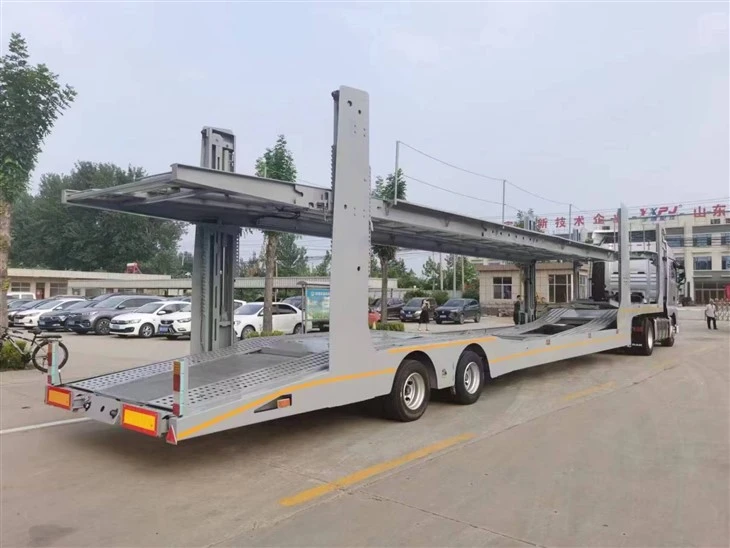
For our trailers, these regulations require us to design them in a way that facilitates easy disassembly and recycling. For example, we should use materials that can be easily separated and recycled at the end of the trailer's life. Steel is a commonly used material in our trailers, and it is highly recyclable. However, we also need to pay attention to other components such as rubber, plastics, and electronic parts. We need to ensure that these components can be properly recycled or disposed of in an environmentally friendly manner.
Some regulations also require us to take responsibility for the proper disposal of our trailers at the end of their useful lives. This may involve establishing take - back programs or working with authorized recycling facilities. By complying with these regulations, we not only contribute to environmental protection but also enhance our reputation as a responsible supplier.
4. Noise Pollution Regulations
Noise pollution is another environmental concern related to 6 car hauler trailers. These trailers, especially when in operation on roads, can generate significant noise. Many urban areas and residential zones have noise pollution regulations that limit the amount of noise that vehicles can produce.
The trucks that tow our trailers must comply with noise emission standards. For example, in some regions, there are limits on the maximum noise level that a heavy - duty vehicle can produce during acceleration and normal operation. As a trailer supplier, we can contribute to reducing noise pollution by ensuring that our trailers are well - maintained and that the connections between the trailer and the truck are properly tightened. Additionally, we can explore the use of noise - reducing materials in the construction of our trailers, such as sound - absorbing insulation.
Navigating the Regulations as a Supplier
As a 6 car hauler trailer supplier, we face several challenges in navigating these environmental regulations. Firstly, we need to stay updated with the latest regulatory changes. This requires us to closely follow the announcements from government agencies and industry associations. We also need to establish good communication channels with our truck - manufacturing partners. By working together, we can ensure that our trailers are compatible with the latest emission - compliant and fuel - efficient trucks.
Secondly, we need to invest in research and development. We need to continuously explore new materials and designs that can help us meet the environmental regulations. For example, we can collaborate with material scientists to develop new lightweight and recyclable materials. We can also work with engineers to optimize the aerodynamics and noise - reducing features of our trailers.
Finally, we need to educate our customers about the environmental benefits of our trailers. Many fleet operators are becoming more environmentally conscious, and they are willing to invest in trailers that are more sustainable. By highlighting the features of our trailers that help reduce emissions, improve fuel efficiency, and are easy to recycle, we can attract more customers.
Our Product Offerings
We offer a wide range of 6 car hauler trailers that are designed with environmental regulations in mind. Our Car Transport Semi - trailer is built with high - quality, recyclable materials and is optimized for aerodynamics to improve fuel efficiency. We also have a selection of Car Hauler Truck And Trailer For Sale that are compatible with the latest low - emission trucks. In addition, our Customized Double Floor Carry 8 Cars Steel Car Carrier Trailer offers a high - capacity solution while still adhering to environmental standards.
Conclusion and Call to Action
Environmental regulations related to 6 car hauler trailers are complex and constantly evolving. However, we believe that these regulations present an opportunity for us to improve our products and contribute to a more sustainable future. By complying with emission, fuel efficiency, recycling, and noise pollution regulations, we can ensure that our trailers are not only environmentally friendly but also meet the needs of our customers.
If you are interested in our 6 car hauler trailers or want to learn more about how we address environmental regulations, we invite you to contact us for further discussion and potential procurement. We are committed to providing you with high - quality, environmentally - friendly trailers that meet your business requirements.
References
- United States Environmental Protection Agency (EPA). Heavy - Duty Engine and Vehicle Standards.
- European Union. Euro Emission Standards for Heavy - Duty Vehicles.
- Various industry reports on fuel efficiency and recycling in the transportation industry.