

Hey there! I'm a supplier of flatbed semi - trailers, and I've seen firsthand how important it is to keep the axles of these trailers properly aligned. In this blog, I'm gonna walk you through how to check the alignment of the axles on a flatbed semi - trailer.
Why is Axle Alignment Important?
Before we jump into the checking process, let's talk about why axle alignment matters. When the axles on your flatbed semi - trailer are misaligned, it can lead to a whole bunch of problems. First off, it causes uneven tire wear. You'll notice that some parts of the tires are wearing out faster than others. This not only shortens the lifespan of your tires but also affects the overall safety of the trailer.
Uneven tire wear can lead to poor traction on the road, especially in wet or slippery conditions. It also makes the trailer harder to control, which is a major safety hazard. Additionally, misaligned axles put extra stress on the suspension system. This can cause premature wear and tear on suspension components, leading to costly repairs down the line.
Tools You'll Need
To check the axle alignment on your flatbed semi - trailer, you'll need a few basic tools. These include a tape measure, a straightedge (like a long, straight piece of metal or wood), and a chalk or a marker. You might also want to have a level handy to make sure the trailer is sitting flat.
Step 1: Prepare the Trailer
The first thing you need to do is park the trailer on a flat and level surface. Make sure the trailer is stationary and the parking brake is engaged. You don't want the trailer moving around while you're trying to check the alignment.
Next, take a look at the tires. Look for any signs of uneven wear, such as bald spots on one side of the tire or excessive wear on the inner or outer edges. This can give you an initial indication of whether the axles might be misaligned.
Step 2: Measure the Distance Between the Axles
Using your tape measure, measure the distance between the centers of the axles at the front and the back of the trailer. Start by measuring the distance between the centers of the first and second axles at the front of the trailer. Write down this measurement. Then, measure the distance between the centers of the same two axles at the back of the trailer.
If the measurements are significantly different, it could be a sign that the axles are misaligned. As a general rule, the difference between the front and back measurements should be no more than 1/8 of an inch. If the difference is greater than this, you'll need to take further steps to correct the alignment.
Step 3: Check the Parallelism of the Axles
To check the parallelism of the axles, you'll use your straightedge. Place the straightedge along the side of the trailer, running parallel to the axles. Make sure the straightedge is touching the tires on both axles.
Using your chalk or marker, mark the points where the straightedge touches the tires on each axle. Then, measure the distance between these marks on each axle. If the distances are the same on both axles, the axles are parallel. If there's a significant difference, the axles are likely misaligned.
Step 4: Inspect the Suspension Components
While you're checking the axle alignment, it's also a good idea to inspect the suspension components. Look for any signs of damage or wear, such as cracked springs, loose bolts, or worn-out bushings. Damaged suspension components can cause the axles to become misaligned, so it's important to address these issues as soon as possible.
Step 5: Make Adjustments (if necessary)
If you've determined that the axles are misaligned, you'll need to make some adjustments. This is a job that's best left to a professional mechanic, especially if you're not familiar with working on trailers. A mechanic will have the tools and expertise to properly realign the axles.

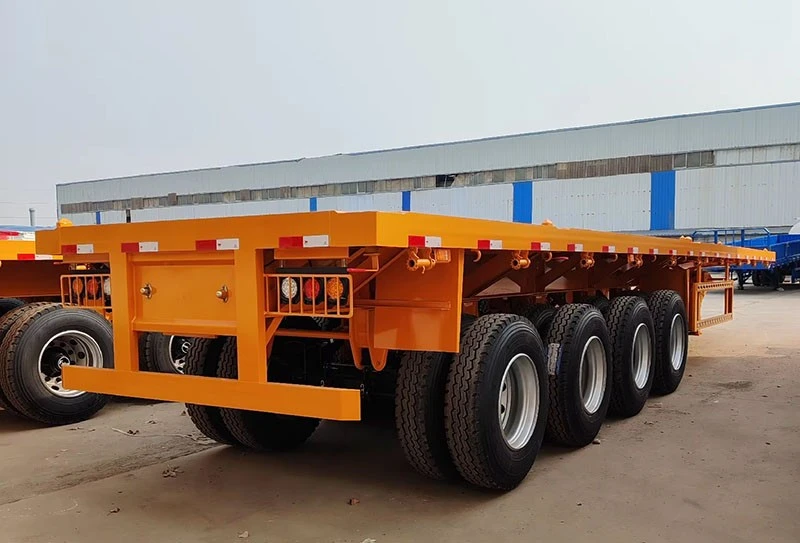
They'll use specialized equipment, such as alignment gauges, to ensure that the axles are aligned correctly. Once the axles are realigned, they'll recheck the measurements to make sure everything is within the acceptable range.
Our Flatbed Semi - Trailers
At our company, we offer a wide range of high - quality flatbed semi - trailers. Whether you need a 60 Ton Low Flatbed Semi Trailer for heavy - duty hauling or a 3 Axles 40 Feet Flatbed Semi Trailer for more standard loads, we've got you covered. We also have the 13m Container Transport Flatbed Semi - Trailer which is great for transporting containers.
All of our trailers are built to last, with proper axle alignment from the factory. But even with the best - built trailers, it's important to regularly check the axle alignment to ensure optimal performance and safety.
Conclusion
Checking the alignment of the axles on a flatbed semi - trailer is an important part of trailer maintenance. By following the steps outlined in this blog, you can catch any alignment issues early and prevent costly repairs and safety hazards.
If you're in the market for a new flatbed semi - trailer, we'd love to talk to you. Our team of experts can help you find the perfect trailer for your needs. Just reach out, and we'll be happy to assist you with your purchase.
References
- "Trailer Maintenance Handbook"
- Industry guidelines on trailer axle alignment