

What is the turning radius of a flatbed semi - trailer?
As a trusted flatbed semi - trailer supplier, I often encounter inquiries from customers about various specifications of our trailers, and one question that comes up frequently is the turning radius of a flatbed semi - trailer. Understanding the turning radius is crucial for both our customers' operational efficiency and safety on the road.
The turning radius of a flatbed semi - trailer refers to the minimum radius of the circle that the outer - most point of the trailer traces when making a turn. It is a key parameter that determines how sharply a vehicle combination (truck and trailer) can turn. Several factors influence the turning radius of a flatbed semi - trailer, and I'll break them down for you.
Firstly, the wheelbase of the tractor and the trailer plays a significant role. A longer wheelbase generally results in a larger turning radius. For instance, when we consider a tandem - axle tractor pulling a long - length flatbed semi - trailer, the distance between the front and rear axles of both the tractor and the trailer is relatively large. This extended wheelbase means that more space is required for the vehicle to make a full turn. In contrast, a shorter - wheelbase setup, such as a single - axle tractor with a shorter flatbed trailer, might be able to navigate tighter turns more easily.
Secondly, the number of axles on the trailer affects the turning radius. Trailers with more axles usually have a larger turning radius. A 3 Axles 40ft Flatbed Trailer, for example, has a more complex steering geometry due to the presence of three axles. The additional axles need to follow different paths during a turn, which in turn increases the minimum radius required for a successful turn compared to a single - axle trailer.
The design of the fifth - wheel coupling also has an impact on the turning radius. The fifth - wheel is the device that connects the tractor to the trailer. A well - designed fifth - wheel can provide more flexibility in the articulation between the tractor and the trailer, allowing for relatively smaller turning radii. Some advanced fifth - wheel designs are engineered to reduce the friction and resistance during turning, enabling smoother and sharper turns.
Terrain and road conditions are also external factors that can influence the effective turning radius. On uneven or slippery surfaces, the trailer's wheels may not follow the ideal path, and the driver may need to make wider turns to maintain control. For example, when driving on a gravel road, the tires may have less grip, and a wider turning arc is necessary to prevent skidding.
So, why is understanding the turning radius so important? In logistics and transportation, it directly impacts route planning. Trucks and trailers with larger turning radii may not be able to access certain areas with narrow roads, sharp corners, or limited turning spaces. This could mean that a delivery route has to be re - evaluated to ensure that the flatbed semi - trailer can reach its destination safely.
Moreover, in terms of loading and unloading operations, the turning radius matters. At a warehouse or a construction site, the trailer needs to be maneuvered into position for loading or unloading. If the turning radius is too large and the site does not have enough space for the trailer to turn, it can lead to delays and inefficiencies in the overall operation.
Let's take a look at some common types of flatbed semi - trailers we offer and their typical turning radii. A 40ft Tri Axle Flat Deck Trailer typically has a relatively large turning radius. Due to its 40 - foot length and three axles, it requires more space to turn compared to a shorter and single - axle trailer. The turning radius can be calculated approximately based on its wheelbase and axle configuration, usually ranging from 20 to 30 meters depending on the specific tractor - trailer combination.

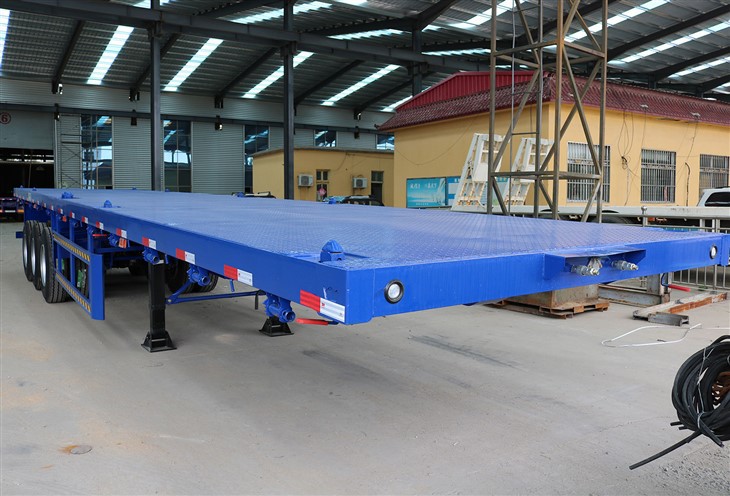
Our 13m Container Transport Flatbed Semi - Trailer also has its own turning characteristics. With a length of 13 meters, it strikes a balance between capacity and maneuverability. The turning radius of this type of trailer is often in the range of 15 to 25 meters, again depending on the tractor it is paired with and other factors such as the fifth - wheel design.
As a supplier, we understand the importance of providing our customers with accurate information about the turning radius. We work closely with our customers to understand their specific needs, such as the types of routes they will be traveling on and the environments in which they will operate the trailers. Based on this information, we can recommend the most suitable flatbed semi - trailer models with the optimal turning radii for their operations.
If you are in the market for a flatbed semi - trailer and want to discuss more about the turning radius or any other specifications, we are here to assist you. Whether you are involved in long - haul transportation, local deliveries, or construction - related logistics, choosing the right trailer with the appropriate turning radius can make a significant difference in your business efficiency and cost - effectiveness.
In conclusion, the turning radius of a flatbed semi - trailer is a multi - faceted concept influenced by multiple factors. By having a clear understanding of these factors and how they interact, you can make more informed decisions when it comes to purchasing a flatbed semi - trailer. Don't hesitate to reach out to us for more in - depth discussions and consultations. We are committed to helping you find the perfect trailer solution for your transportation needs.
References
- "Transportation Engineering Handbook" - A comprehensive resource on vehicle specifications and road - related engineering concepts.
- Company - internal technical documents on flatbed semi - trailer design and performance.