

As a supplier of Car Carrier Semi - Trailers, I often encounter customers who are confused about what kind of trucks are suitable to pull these semi - trailers. In this blog, I'll delve into the key factors to consider when choosing a truck for this purpose and recommend some suitable truck types.
Key Factors in Selecting a Truck for Car Carrier Semi - Trailers
1. Towing Capacity
The most crucial factor is the truck's towing capacity. A car carrier semi - trailer can be quite heavy, especially when fully loaded with vehicles. The towing capacity of a truck is determined by its engine power, transmission, axle ratio, and braking system. For example, a small - scale car carrier semi - trailer that can carry 2 - 3 cars might require a truck with a towing capacity of at least 10,000 pounds. Larger semi - trailers that can transport 6 - 8 cars may need a truck with a towing capacity of 20,000 pounds or more.
It's essential to match the towing capacity of the truck with the weight of the loaded semi - trailer. Overloading the truck can lead to serious safety issues, such as poor braking performance, increased tire wear, and even engine and transmission damage.
2. Axle Configuration
The axle configuration of the truck also plays a vital role. Trucks with more axles generally have better weight distribution and stability. For instance, a tandem - axle truck (two rear axles) can handle heavier loads compared to a single - axle truck. This is because the additional axles spread the weight of the trailer and its cargo more evenly, reducing the stress on each individual axle.
In addition, some trucks are equipped with a lift axle. A lift axle can be raised or lowered as needed. When the truck is not fully loaded, the lift axle can be raised to reduce tire wear and improve fuel efficiency. When carrying a heavy load, the lift axle can be lowered to increase the truck's weight - carrying capacity and stability.
3. Braking System
A reliable braking system is non - negotiable when towing a car carrier semi - trailer. The combined weight of the truck and the loaded semi - trailer is much greater than that of a regular vehicle. Therefore, the truck must have a braking system that can effectively stop this heavy combination.
Many modern trucks are equipped with air brakes, which are more powerful and reliable than hydraulic brakes. Air brakes use compressed air to activate the brakes, providing quick and consistent braking performance. Additionally, some trucks are equipped with an anti - lock braking system (ABS), which helps prevent the wheels from locking up during braking, reducing the risk of skidding and improving control.
4. Suspension System
The suspension system of the truck affects the ride quality and handling of the combined vehicle. A good suspension system can absorb shocks and vibrations from the road, ensuring a smooth and stable ride. This is especially important when transporting valuable vehicles on the semi - trailer.
There are different types of suspension systems available, such as leaf spring suspension and air suspension. Leaf spring suspension is a traditional and cost - effective option. It is known for its durability and ability to handle heavy loads. Air suspension, on the other hand, provides a more comfortable ride by adjusting the air pressure in the suspension bags according to the load and road conditions.
5. Transmission
The transmission of the truck impacts its performance when towing. Automatic transmissions are generally more convenient, especially for drivers who are not experienced in manual shifting. They can automatically adjust the gear ratio based on the speed and load of the vehicle, providing a smooth driving experience.
Manual transmissions, however, offer more control. They allow the driver to select the appropriate gear for different driving conditions, such as climbing hills or descending slopes. This can be beneficial when towing a heavy car carrier semi - trailer, as the driver can optimize the engine's power output and fuel efficiency by manually selecting the right gear.
Suitable Truck Types for Car Carrier Semi - Trailers
1. Heavy - Duty Pickup Trucks
Heavy - duty pickup trucks are a popular choice for towing smaller car carrier semi - trailers. Models like the Ford F - 350, Chevrolet Silverado 3500, and Ram 3500 offer high towing capacities, typically ranging from 15,000 to 35,000 pounds. These trucks are relatively compact and maneuverable, making them suitable for urban and suburban areas.
They are also equipped with powerful engines, advanced braking systems, and comfortable interiors. Many heavy - duty pickups come with features like trailer sway control, which helps keep the semi - trailer stable while towing. However, their payload capacity may be limited compared to larger commercial trucks, so they are more suitable for transporting a small number of vehicles.
2. Medium - Duty Trucks
Medium - duty trucks, such as the Isuzu NPR - HD and the Ford F - 650, are another option. These trucks have a higher payload capacity than heavy - duty pickups and are designed for more demanding towing tasks. They typically have a gross vehicle weight rating (GVWR) between 14,001 and 26,000 pounds.
Medium - duty trucks often come with a variety of engine and transmission options, allowing customers to choose the configuration that best suits their needs. They are also available with different body styles, such as cab - over - engine (COE) and conventional cab designs. COE trucks have a shorter wheelbase and better maneuverability, while conventional cab trucks offer more interior space and a more comfortable driving position.
3. Heavy - Duty Commercial Trucks
For large - scale car carrier semi - trailers that can transport 6 or more vehicles, heavy - duty commercial trucks are the ideal choice. Brands like Kenworth, Peterbilt, and Freightliner offer a wide range of heavy - duty trucks with towing capacities that can exceed 50,000 pounds.
These trucks are built for long - haul and heavy - load operations. They are equipped with powerful engines, heavy - duty transmissions, and advanced braking and suspension systems. Heavy - duty commercial trucks also offer a high level of customization, allowing customers to choose features such as sleeper cabs for long - distance drivers, advanced safety systems, and fuel - efficient technologies.
Our Car Carrier Semi - Trailers
At our company, we offer a wide range of high - quality car carrier semi - trailers to meet different customer needs. Our 2 - Axle Vehicle Transport Semi - Trailer is a great option for transporting a small number of vehicles. It is lightweight yet durable, with a well - designed structure that ensures the safety of the transported cars.
Our Car Transport Semi - trailer is suitable for medium - scale vehicle transportation. It features a flexible loading system that can accommodate different types and sizes of vehicles.
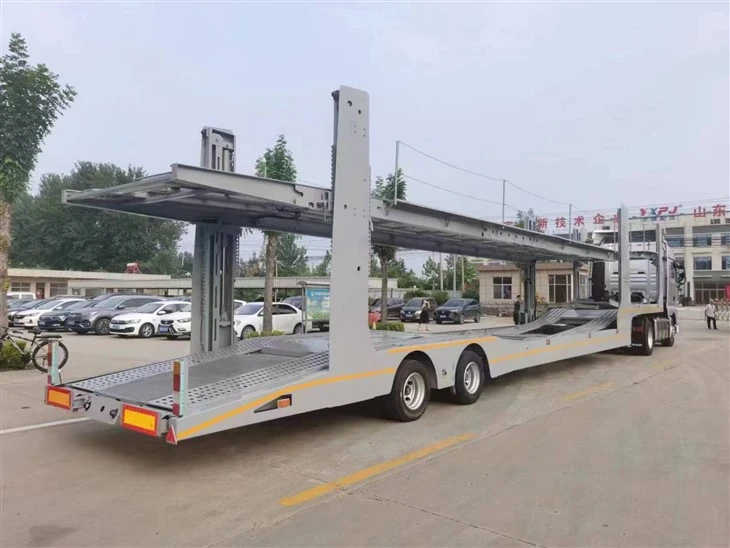

If you are looking to buy a complete car hauler truck and trailer package, we also have Car Hauler Truck And Trailer For Sale. Our packages are carefully selected and matched to ensure optimal performance and reliability.
Conclusion
Selecting the right truck to pull a car carrier semi - trailer is a complex decision that requires careful consideration of factors such as towing capacity, axle configuration, braking system, suspension system, and transmission. By choosing the appropriate truck and matching it with a high - quality semi - trailer, you can ensure a safe, efficient, and profitable vehicle transportation operation.
If you are interested in our car carrier semi - trailers or need more information about truck - trailer compatibility, please feel free to contact us. Our team of experts is ready to assist you in making the best choice for your business.
References
- "Truck Towing Guide" - Published by a leading automotive magazine.
- Manufacturer brochures of major truck brands such as Ford, Chevrolet, Kenworth, etc.
- Industry reports on vehicle transportation and semi - trailer technology.